


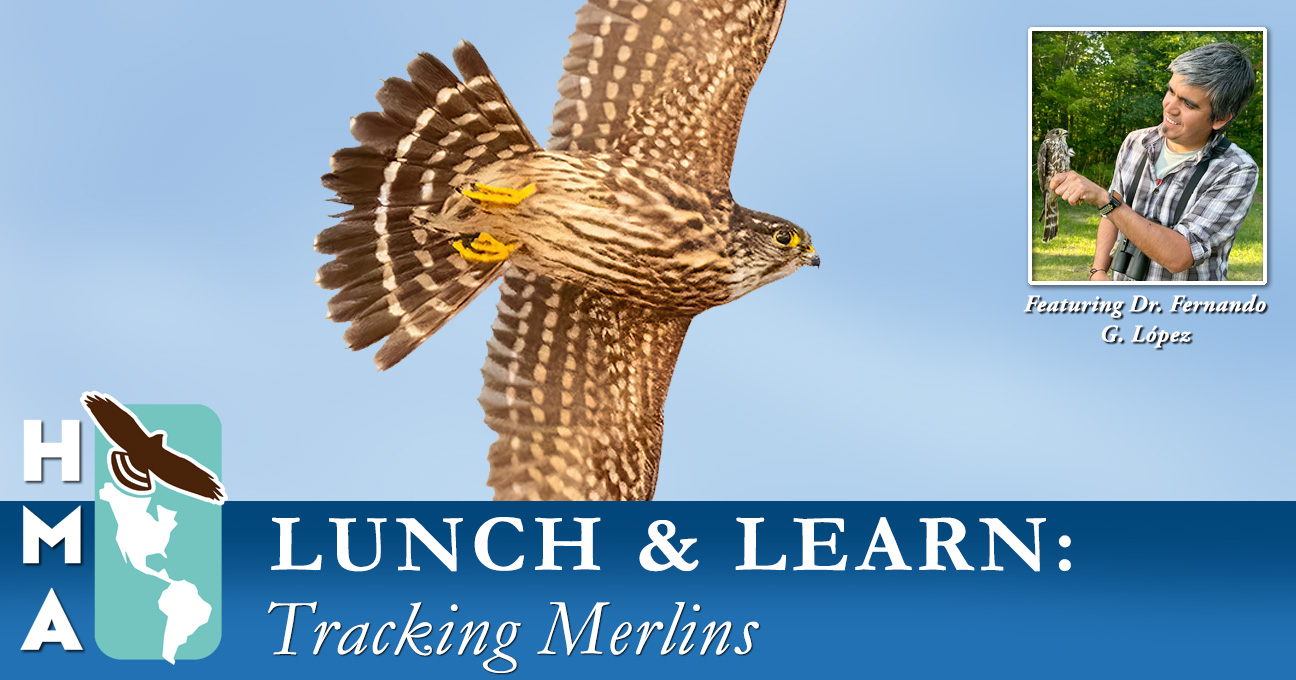
For our January Lunch & Learn series, we welcome Dr. Fernando G. López who will speak about his Merlin research on January 28th at 12pm eastern.
Conflicts between native predators and endangered species present complex challenges for conservation. In this talk, Dr. Fernando López will present results from a multi-year study of Merlins (Falco columbarius) in the Great Lakes region, where recent range expansion has increased predation pressure on the endangered Piping Plover (Charadrius melodus). Using satellite tracking, space-use analyses, diet studies, and experimental non-lethal translocations, this research provides new insights into Merlin ecology and evaluates management strategies aimed at reducing predation risk while maintaining ecosystem integrity.
Beyond the scientific results, the talk will also reflect on how conservation science can move beyond traditional academic boundaries. Fernando will briefly introduce et al blog, a project of ornithology without frontiers that connects science, conservation, and society across the Americas, exploring how research can generate impact through collaboration, communication, and shared knowledge.
Fernando López, Ph.D. is an Argentine ornithologist and ecologist with extensive research experience across the Americas. He completed his Ph.D. studying the reproductive ecology of American Kestrels (Falco sparverius) nesting in natural tree cavities, and has worked on a wide range of topics including raptor ecology, species conservation, and human–wildlife interaction. As a postdoctoral fellow at the Smithsonian Institution, he led research on the satellite tracking and non-lethal management of Merlins to support recovery efforts for the endangered Piping Plover in the Great Lakes. Fernando has more than 20 scientific publications in avian ecology and conservation, collaborating with international teams across disciplines. He and his wife, Dr. Emilia Rebollo (ornithologist too) recently launched et al blog (www.etalblog.com and @etalblog on various social media platforms)— a new project in science communication and public engagement, rooted in the idea of ornithology without frontiers, aimed at connecting science, people, and biodiversity through a motorhome journey across the Americas.